
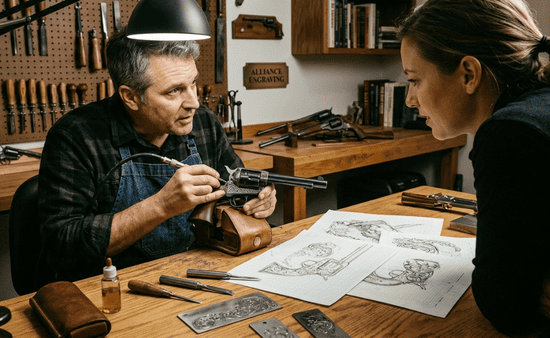
A firearm is often one of the more personal items a person owns — and having it engraved is a decision that deserves the same care as the piece itself. Understanding what goes into quality engraving work helps you choose the right craftsman and set realistic expectations before the work begins.
Why Firearm Engraving Is a Distinct Craft
Engraving a firearm isn’t the same as engraving a trophy or a piece of jewelry. The materials involved — hardened steel, aluminum alloys, case-hardened receivers — behave differently under a graver than softer metals do. The geometry of a firearm also presents challenges that flat or simple curved surfaces don’t: tight radii, interrupted surfaces, and areas where the metal thickness affects how deeply a cut can safely go.
Craftsmen who work exclusively on firearms develop an understanding of those constraints that generalist engravers don’t have. They know which areas of a given platform can accept deep relief work and which require a lighter touch. They understand how different metal finishes — blued steel, stainless, anodized aluminum — respond to engraving and how that affects the design approach.
Hand Engraving Versus Machine Engraving
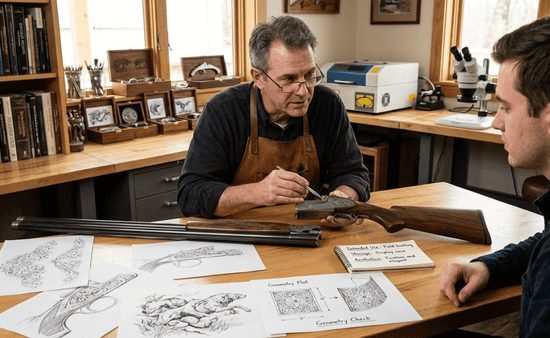
The distinction between hand engraving and machine engraving matters more than most first-time customers realize. Machine engraving — including laser engraving and CNC pantograph work — produces consistent, repeatable results and is well-suited for serial numbers, simple text, and basic patterns. It’s faster and typically less expensive.
Hand engraving is a different category entirely. A skilled hand engraver uses specialized gravers to cut directly into the metal, creating lines with variable depth and width that catch light in ways machine work can’t replicate. Scrollwork, portraits, wildlife scenes, and decorative borders done by hand have a dimensionality and character that makes them immediately distinguishable from machine output. For heirloom pieces, commemorative firearms, or any work where the engraving is meant to be the focal point, hand engraving is the standard worth pursuing.
Design Consultation and What It Should Cover
A good engraving consultation isn’t just a conversation about what pattern you want. It’s a conversation about how the firearm will be used, how it will be stored and displayed, and what the engraving needs to accomplish visually given the geometry of the specific platform.
A pattern that looks striking on a flat receiver panel may not translate well to a curved grip frame. Text that reads clearly on paper may become difficult to read when cut into a complex background pattern. An experienced craftsman will raise these issues during consultation — not after the work has started — and will offer alternatives that achieve the intended result within the constraints of the piece.
Metal Condition and Preparation
The condition of the metal before engraving begins affects the quality of the finished work. Pitting, surface rust, prior tool marks, or an inconsistent existing finish all create challenges that need to be addressed — or at minimum, acknowledged — before cutting starts.
Some craftsmen offer light polishing or surface preparation as part of their process. Others prefer to work the metal as-received and let the engraving speak for itself. Neither approach is universally correct, but knowing what condition your firearm needs to be in before it’s submitted — and what the craftsman’s process for preparation is — avoids surprises when the piece comes back.
What Custom Work Actually Costs and Why
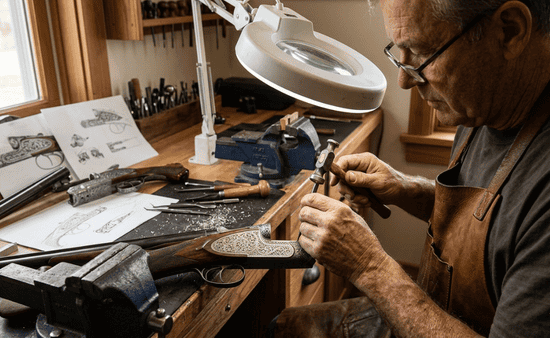
Custom gun engraving in the Alliance area, like anywhere with skilled craftsmen, is priced based on time — specifically, the number of hours a design requires to execute at the level of quality the craftsman maintains. A quarter-coverage scroll pattern and a full-coverage portrait scene aren’t in the same pricing category, and they shouldn’t be.
Requests for unusually low pricing on complex hand work are a reliable indicator that corners will be cut somewhere — in design time, in execution speed, or in the depth and quality of the cuts themselves. A craftsman who prices their work honestly and explains what drives the cost is a better partner than one who matches a budget at the expense of the outcome.
Turnaround, Communication, and Managing Expectations
Custom engraving takes time, and the best craftsmen are typically not the fastest ones to get an appointment with. A realistic turnaround for quality hand engraving on a complex design — from intake to delivery — can range from several weeks to several months depending on the craftsman’s current workload and the scope of the project.
What matters more than speed is communication. A craftsman who provides design sketches or mockups before cutting begins, who checks in at key stages of the project, and who is reachable with questions gives you visibility into the process and the ability to course-correct before a decision becomes permanent.
Conclusion
Having a firearm engraved is a commitment to that piece — one that adds meaning, history, and craft to something already built to last. Taking the time to find the right craftsman, ask the right questions, and understand what the process involves is what leads to finished work you’ll want to pass down.