
I remember back in high school, I’d stare at quadratic equations and wonder how anyone could make sense of them. The formula looked like a jumble of symbols that seemed way too complicated.
But once I figured out how to use the quadratic equation, everything clicked. Suddenly, what felt like a puzzle became a straightforward solution.
If you’re looking at a quadratic equation and thinking, “Walk me through how to use the quadratic equation,” you’ve come to the right place. In this guide, I’ll walk you through step-by-step how to solve these equations, so you can confidently tackle them yourself.
What Is the Quadratic Equation?
Let’s start with the basics. A quadratic equation is any equation that can be written in the standard form:
ax2+bx+c=0ax^{2} + bx + c = 0ax2+bx+c=0
Here:
- a, b, and c are constants (numbers).
- x is the variable you’re trying to solve for.
It’s called a “quadratic” because the highest degree of the variable is 2 (the x2x^2×2 term). This is the hallmark of all quadratic equations. And the quadratic formula is the tool you’ll use to solve it.
Why Use the Quadratic Formula?
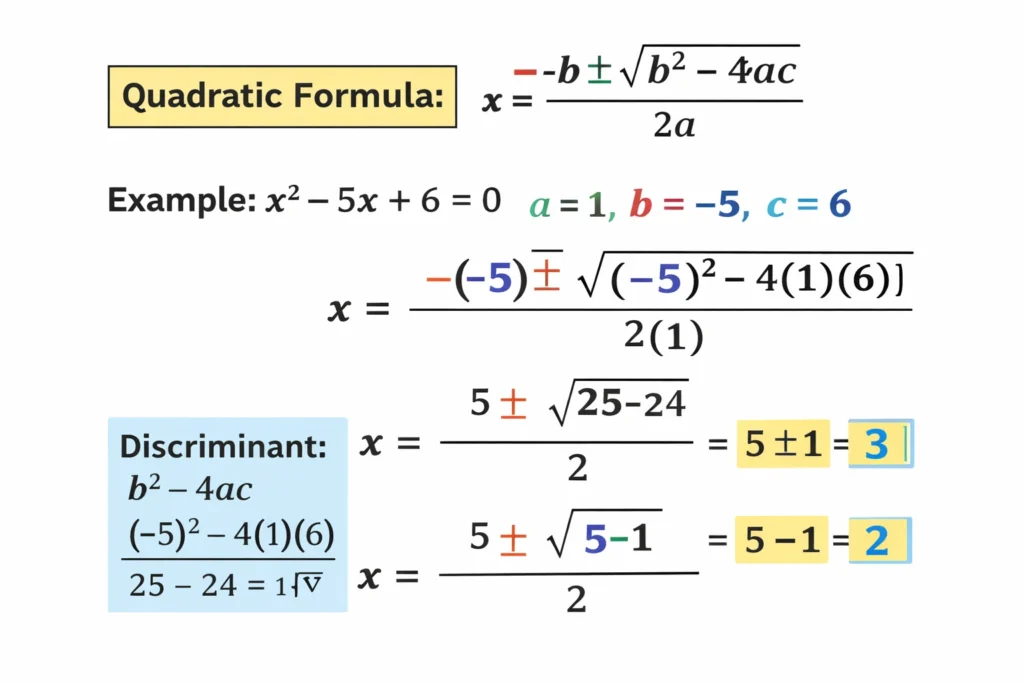
If you can’t easily factor the quadratic equation (sometimes factoring just isn’t an option), then the quadratic formula is your best friend. It allows you to solve any quadratic equation, even when factoring seems impossible.
The quadratic formula is:
x=−b±b2−4ac2ax = \frac{-b \pm \sqrt{b^2 – 4ac}}{2a}x=2a−b±b2−4ac
Yes, it looks intimidating at first, but once you break it down, it becomes pretty simple to apply. Let’s walk through it step by step.
How to Use the Quadratic Equation: Step-by-Step

Step 1: Set the Equation to Standard Form
Before you use the quadratic formula, make sure your equation is in standard form:
ax2+bx+c=0ax^2 + bx + c = 0ax2+bx+c=0
If your equation isn’t in this form, move all terms to one side to set it equal to zero. For example, if you have:
x2+4x=5x^2 + 4x = 5×2+4x=5
Subtract 5 from both sides:
x2+4x−5=0x^2 + 4x – 5 = 0x2+4x−5=0
Now you’re ready to apply the quadratic formula!
Step 2: Identify the Coefficients
Next, identify the coefficients a, b, and c in your equation. These are the numbers in front of the x2x^2×2, xxx, and the constant term. For the equation:
x2+4x−5=0x^2 + 4x – 5 = 0x2+4x−5=0
- a = 1 (since there’s no number in front of x2x^2×2, it’s 1)
- b = 4 (the coefficient in front of xxx)
- c = -5 (the constant term)
Step 3: Plug the Values Into the Formula
Now comes the fun part. Take your values for a, b, and c and plug them into the quadratic formula:
x=−b±b2−4ac2ax = \frac{-b \pm \sqrt{b^2 – 4ac}}{2a}x=2a−b±b2−4ac
Substitute in the values from the example:
x=−4±42−4(1)(−5)2(1)x = \frac{-4 \pm \sqrt{4^2 – 4(1)(-5)}}{2(1)}x=2(1)−4±42−4(1)(−5)
Step 4: Solve the Discriminant First
The discriminant is the part under the square root: b2−4acb^2 – 4acb2−4ac. In our example:
b2−4ac=42−4(1)(−5)=16+20=36b^2 – 4ac = 4^2 – 4(1)(-5) = 16 + 20 = 36b2−4ac=42−4(1)(−5)=16+20=36
If the discriminant is positive, you’ll get two real solutions. If it’s zero, you’ll get one solution. If it’s negative, you’ll get complex solutions.
Step 5: Calculate the Final Solutions
Now that we have the discriminant, we can calculate the rest of the equation:
x=−4±362(1)x = \frac{-4 \pm \sqrt{36}}{2(1)}x=2(1)−4±36 x=−4±62x = \frac{-4 \pm 6}{2}x=2−4±6
Now, solve for both values of x:
- Using the plus sign:
x=−4+62=22=1x = \frac{-4 + 6}{2} = \frac{2}{2} = 1x=2−4+6=22=1 - Using the minus sign:
x=−4−62=−102=−5x = \frac{-4 – 6}{2} = \frac{-10}{2} = -5x=2−4−6=2−10=−5
So the two solutions are x = 1 and x = -5.
Frequently Asked Questions
1. What happens if the discriminant is negative?
If the discriminant (b2−4acb^2 – 4acb2−4ac) is negative, this means that the quadratic equation has no real solutions. Instead, you’ll have imaginary or complex solutions. You can calculate these using the square root of the negative number, resulting in imaginary numbers (like ±i\pm i±i, where iii is the imaginary unit).
2. What is the historical significance of the quadratic formula?
The quadratic formula has been around for centuries. Ancient civilizations like the Babylonians and Egyptians had methods for solving quadratic equations, but the formula as we know it today was formally derived by mathematicians such as Al-Khwarizmi in the 9th century. It’s one of the foundations of algebra.
3. What does it mean to solve a quadratic equation?
Solving a quadratic equation means finding the value(s) of x that make the equation true. For a quadratic equation in standard form (ax2+bx+c=0ax^2 + bx + c = 0ax2+bx+c=0), you can find two solutions using the quadratic formula, factoring, or completing the square.
4. Why do we use the quadratic formula?
We use the quadratic formula because it provides a universal method for solving any quadratic equation, regardless of whether it can be factored easily. It ensures that you can always find a solution for x, even in tricky cases where factoring doesn’t work.
Conclusion: Master the Quadratic Formula for Effortless Solving
The quadratic formula may seem intimidating at first, but once you break it down step by step, it becomes a simple tool to solve any quadratic equation.
By identifying the coefficients, plugging them into the formula, and solving the discriminant, you can easily find your solutions—whether they’re real or imaginary.
Pro Tip: Practice makes perfect. The more you work with the quadratic formula, the quicker and more confident you’ll become in solving these equations.